How to Keep Up Your Fitness Routine While Traveling
The latest blog from Elaine Economou about working out while traveling is now posted on the popular website, Sixty and Me.
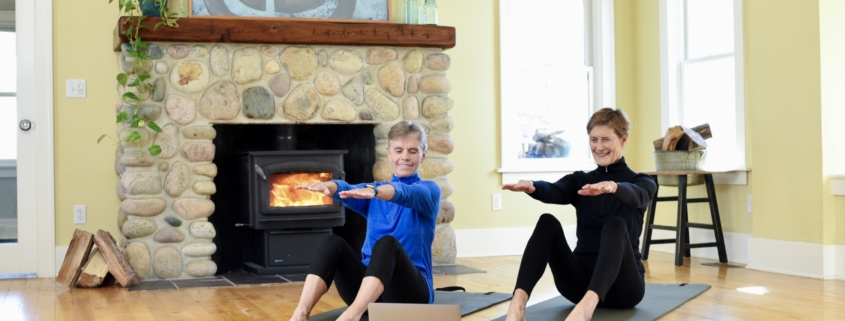
“Once you evaluate the when and where of a travel exercise routine, figuring out how you will exercise is the next step. With internet access you can do virtually (pun intended!) anything you want. Online fitness options—both on demand workouts and livestream classes—are widely available. You don’t need to have any fancy equipment or props taking up space in your suitcase. Use a beach towel instead of a mat and water bottles as hand weights. That book you brought along to read on your trip can make a great substitute yoga block.”
—Elaine Economou
Tips for Working Out While Traveling
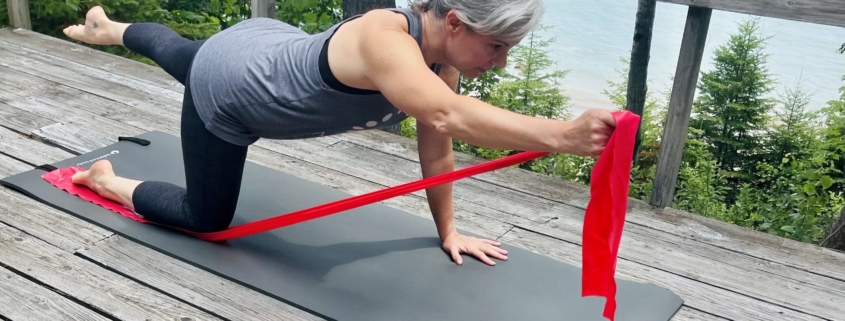
In this blog, Elaine will guide you though how to think about your available time and space on vacation. She’ll break down the advantages of the various online workout options. And, she’ll talk about what type of exercise you need most when you’re on the road. Give the following 30-minute Level 1 Pilates class a try on your next vacation using therabands for resistance. Perfect for your suitcase! Be sure to read the full blog over on Sixty and Me to learn even more strategies.
We know the more you move, the better you feel. That includes finding smart ways to make movement part of your routine, even when traveling. For wherever life takes you or from the comfort of your very own home, MOVE Wellness offers your first livestreamed class free! Support the activities you love to do in life by starting today!
Elaine Economou helps people move with ease, strength, and joy. Her passion is empowering people to understand their unique bodies to build strength, and do more of what they love. As co-founder of MOVE Wellness®, Elaine leads a global movement community of clients in high-caliber, in-studio, and interactive livestream training.
Find all of Elaine’s Sixty and Me blogs on her author page.
https://www.movewellness.com/wp-content/uploads/2023/11/IMG_2214_Original-scaled-1.jpg20482560ijtdevhttps://www.movewellness.com/wp-content/uploads/2023/07/MOVE-Wellness-Website-Logo.pngijtdev2021-08-27 19:30:002026-05-18 11:07:43Working Out While Traveling: How to Keep Up Your Fitness Routine
Yoga and Aging: The Benefits of Yoga as We Get Older
As we get older, we find ourselves looking for ways to offset the day to day effects of aging. For some, it’s as simple as wanting to reduce the little aches and pains that creep into our days. For others, the goal might be to build strength and mobility to move through life with ease. Or, we may be looking for ways to manage stress and build a mindfulness practice into our daily routine so we enjoy and appreciate our life. Whatever your individual goals, the phrase “active aging” may hold the key.
According to the International Council on Active Aging, active aging means staying fully engaged with life in seven dimensions of wellness—physical activity and spiritual pursuits are two of them. By staying active, you can continue to lead a healthy life at any age or stage without losing mobility or your balance. Yoga is a popular way to help you achieve these goals.
Benefits of Yoga as You Age
A well rounded exercise routine will help you continue to do the things you love in life. Yoga is often the first thing people think of to facilitate healthy aging with a wide range of benefits. A lot of times, we hear people say that they just need to stretch more. Yoga comes to mind quickly when they think about how to solve this problem. Truthfully, the practice of yoga does help the body stay flexible and as we age—an important aspect of staying balanced and mobile. But there are many other benefits of a regular yoga practice. It can be an important part of a well rounded fitness plan.
Let’s break it down. First, when we practice yoga we are stretching and opening the body by moving into and holding poses to help keep the joints mobile and strong. Moving regularly can help minimize inflammation to keep day-to-day aches and pain away. Beyond the muscular system, breathing and mindfulness are at the top of the benefits list for ways yoga can help us combat the physiological impact of stress. When we can reduce stress and increase breathing and mindfulness we stand to sleep better and maintain healthy blood pressure. And finally, in practicing yoga the deep focus on the movements and sensations of the body will build awareness and keep you mentally sharp.
Fewer Aches and Pains
Who doesn’t want to feel better throughout the day? A yoga class will help you mobilize all the joints in your body as you move through specific poses, or asanas. Bringing circulation to each part of the body will help it stay supple and minimize inflammation. This can be one cause of simple muscle aches and pains. Stretching your legs, hips, back, and shoulders will help you bring your muscular system into balance. When you move during your day doing all the things you enjoy, all your muscles will be trained to join in and participate offering your body more support. Yoga also promotes physical and mental health, enhancing mobility, balance, and cognitive function while reducing anxiety and depression.
Strength, Mobility, and Balance
A yoga practice can help you manage the activities of daily living by keeping your body resilient and strong. Moving through the asanas and stretching your body in a variety of ways helps keep your tissues supple—including muscles, ligaments and tendons, and all the connective tissues or fascia. That might sound complicated, but it all comes down to building strength and mobility throughout your body.
By getting stronger, we will improve our balance safely and keep our body resilient. We will be more responsive to catching ourselves if we momentarily lose our balance. As we age this can be crucial in preventing injuries caused by a stumble or fall. Yoga also promotes increased circulation and oxygenation of the body which will help you feel energized and refreshed after a great class.
The Science Behind Yoga for Healthy Aging
Research has shown that a consistent yoga practice can significantly impact physical and mental health, especially as we age. Studies have found that yoga can improve physical fitness and mobility, enhance brain health, and reduce the risk of age-related cognitive decline. Additionally, yoga supports mental health by reducing stress and anxiety, promoting healthy aging practices, and lowering the risk of premature aging.
One of the key scientific concepts behind yoga and healthy aging is “inflammaging,” which refers to the chronic, low-grade inflammation that occurs as we age. Yoga has been shown to combat this by reducing oxidative stress and improving cellular health. It also enhances immune function, promotes healthy telomere length, and supports healthy gene expression, all of which contribute to reducing the risk of age-related diseases and cognitive decline.
By incorporating yoga into your daily routine, you can promote healthy aging, improve sleep quality, and enhance overall well-being. This holistic approach not only supports physical and mental health but also helps you maintain a higher quality of life as you age.
Breathing and Awareness
Yoga has a long history associated with a religious or spiritual practice. Over time, yoga has evolved to allow us to participate in a way that connects us to the truth of what’s in our own heart and who we are in the moment. For some of us this may feel more universally approachable and accessible. As we practice this idea of deeply listening to ourselves, we can foster self-compassion and self-love and bridge the truths of our miraculous body and our lives. Who wouldn’t want healthy movement, peace, and energy all tied together into one practice?
A key component of any yoga practice is mindful breathing. As we breathe we also focus on how we breathe and even different types of breath practice. This can help minimize the physiological impact of stress, reduce blood pressure, and calm anxiety. Breathing well and fully will also help your pelvic floor and core muscles work organically to bring tone to the muscles that support a healthy trunk and strong back. By really tuning into our breath throughout our yoga practice, we will steadily improve our focus and concentration. Following the guidance of a great teacher we will build awareness of the sensations of the body that can help us meaningfully tune in to how we feel day to day.
https://youtu.be/nMXCzB1kpOU
Yoga for Older – Classes for Healthy Aging
There are a lot of different yoga classes out there to choose from. If you’re ready to see how yoga can enhance your movement routine, step one is getting permission from your physician so you can exercise safely. Finding a class that helps you move at a level appropriate for you is important. Many of them can be adapted for any level of movement and for different populations. This article is a really nice primer describing the different types of yoga—from Restorative to Hatha or Vinyasa and anything in between, this will help you decide where to start. There are so many options, including livestream classes with a real-time instructor, recorded on-demand to practice at your own convenience, or in-person group fitness in a studio.
We like to recommend starting with a Gentle Yoga class if you’re unsure what level you might be comfortable with. You can also reach out to the teacher beforehand directly to help you choose. If you have balance issues or difficulty getting down on the floor, a chair yoga class may work best until you get more steady on your feet.
Or, an osteoporosis-safe yoga class may be best for those with that issue. Speaking to the instructor before class is particularly important if you have any health issues or injuries. They might have advice or modifications to help you feel comfortable and safe throughout class. Always stop if you feel any pain or discomfort and seek medical advice before going any further.
Yoga for older adults at MOVE Wellness in Ann Arbor, Michigan
Join us for interactive, livestream yoga and meditation classes with MOVE Wellness Studios. Our classes are designed to meet a variety of client needs and represent a practice that speaks from the teacher’s heart. At MOVE, we pride ourselves on creating a welcoming environment. We strive to empower each client on their personal path to fitness and wellness. As we’ve learned through this article, there are many effective yoga systems. We offer diverse classes that are accessible to all people.
Our Gentle Yoga class moves at a slow to moderate pace. Traditional yoga concepts are introduced in a format that is clear and easy to understand. You’ll practice poses with an emphasis on breathing, physical awareness and relaxation. This will allow you to increase strength and flexibility while relieving stress.
Our Rest and Restore Class (Yoga Nidra) features gentle movements and relaxation techniques. These movements are designed to relieve muscular tension, calm the nervous system and quiet the mind.
We also offer a guided Mindfulness and Meditation opportunity. This non-movement class focuses on various techniques such as body scans, breath awareness and mantras to help focus the mind and be present in the moment.
Yoga for Healthy Aging – You Can Start Now
With MOVE Livestream, you’ll enjoy yoga classes and more with our expert instructors from the comfort of your own home. Let us help you find the class that’s right for you. Get started today with your first class free!
Alicia Head became a GYROKINESIS® master trainer in 2004. She studied exclusively with Juliu Horvath throughout the entire process and has also taken many continuing education courses with him including Happy Moves, Lotus Blossom #1 and #2, the GYROKINESIS® Breathing Course Intensive, GYROKINESIS® Level 2, the Archway, and the Jumping Stretching Board. Ms. Head’s mind-body movement journey began as a Pilates student at St. Francis Memorial Hospital’s Dance Medicine division, where her main teachers were Elizabeth Larkam and Nora St. John. Alicia later studied closely with Marie-José Blom at her Long Beach Dance Conditioning studio in Long Beach, CA where the approach to movement was depth-oriented. Great attention was given to the concept of core stabilization involving a dynamic process free of bracing or rigidity. Alicia has taught GYROKINESIS® Level 1 Foundation Teacher Training courses for 14 years and has observed the need for material that explores the principles of the GYROTONIC® method that is accessible to all people. She was delighted to connect with Gina Muensterkoetter and become part of her project to offer new GYROKINESIS® formats to the international community. GYROKINESIS® Essentials — A Journey of Spinal Motions Part 1 was finalized in March 2017 and Alicia is honored to be on the teaching team.
Register Today!
Please contact us with any questions. Online registration is available by clicking the buttons below. You may also register by calling us at 734-224-2560 or in-person at the studio.
Mark your calendars and plan to join us October 1–3 as GYROKINESIS® master trainer, Alicia Head visits MOVE to present a continuing education course for instructors as well as classes open to the community.
COST: $175 Studio fee due upon registration, plus $350 course fee to be paid directly to Alicia.
SCHEDULE:
Friday, October 1, 12:00–2:00 p.m. and 4:00–7:00 p.m.
Saturday, October 2, 10:00 a.m.–12:00 p.m. and 2:00–5:00 p.m.
Sunday , October 3, 9:00 a.m.–11:00 a.m. and 12:00–3:00 p.m.
This 3-day course is a dynamic and systematic approach to preparing the spine and nervous system for the full formats featured in GYROKINESIS® Level 1. Each format was developed for a 60-to-90 minute class and they can be presented either as a progression or independently. This course satisfies continuing education and update requirements for certified GYROKINESIS® instructors as well as GYROTONIC® instructors who are also certified in GYROKINESIS®.
These GYROKINESIS® formats explore three different aspects of spinal motions — lumbar, thoracic, and cervical. The classes still follow the basic sequencing — Awakening of the Senses, Spinal Motions, and either standing or floor work — but the stimulation to the nervous system is more gentle and gradual. GYROKINESIS® Essentials of Spinal Motions Part 1 is perfect for beginner level students and also for experienced people who enjoy deepening the work. This approach allows us to discover more about the internal process of elongating the spine and how to best prepare our bodies for energetic awakenings. The formats also work beautifully as a warm-up for private sessions or group classes — either GYROTONIC® or GYROKINESIS® — and they shed some more light on the concepts of Narrowing the Pelvis and Supple-ing.
MOVE clients and the greater community are invited to join us as Alicia teaches her Essentials classes throughout her weekend training. Each class will explore a different aspects of spinal motions — lumbar, thoracic, and cervical. The classes still follow the basic sequencing — Awakening of the Senses, Spinal Motions, and either standing or floor work — but the stimulation to the nervous system is more gentle and gradual. GYROKINESIS® Essentials of Spinal Motions Part 1 is perfect for beginner level students and also for experienced people who enjoy deepening the work. Choose to attend one class or join us for all three.
WHEN: October 1–3, 2021 at MOVE Wellness Studios
WHO: MOVE clients and the greater community
COST: $45 per class.
SCHEDULE:
Lumbar spine: Friday, October 1, 12:00–2:00 p.m.
Thoracic spine: Saturday, October 2, 10:00 a.m.–12:00 p.m.
Cervical spine: Sunday, October 3, 9:00–11:00 a.m.
Alicia Head became a GYROKINESIS® master trainer in 2004. She studied exclusively with Juliu Horvath throughout the entire process and has also taken many continuing education courses with him including Happy Moves, Lotus Blossom #1 and #2, the GYROKINESIS® Breathing Course Intensive, GYROKINESIS® Level 2, the Archway, and the Jumping Stretching Board. Ms. Head’s mind-body movement journey began as a Pilates student at St. Francis Memorial Hospital’s Dance Medicine division, where her main teachers were Elizabeth Larkam and Nora St. John. Alicia later studied closely with Marie-José Blom at her Long Beach Dance Conditioning studio in Long Beach, CA where the approach to movement was depth-oriented. Great attention was given to the concept of core stabilization involving a dynamic process free of bracing or rigidity. Alicia has taught GYROKINESIS® Level 1 Foundation Teacher Training courses for 14 years and has observed the need for material that explores the principles of the GYROTONIC® method that is accessible to all people. She was delighted to connect with Gina Muensterkoetter and become part of her project to offer new GYROKINESIS® formats to the international community. GYROKINESIS® Essentials — A Journey of Spinal Motions Part 1 was finalized in March 2017 and Alicia is honored to be on the teaching team.
Register Today!
Please contact us with any questions. Online registration is available by clicking the buttons below. You may also register by calling us at 734-224-2560 or in-person at the studio.
Maybe you’ve heard of Gyrokinesis exercise, but aren’t exactly sure what it entails. You might be wondering what it’s all about and how it might benefit you. Elaine’s blog will cover:
Read the full blog to learn more about the benefits of this wonderful movement system. Gyrokinesis classes are an efficient, effective, and safe way to increase your flexibility, develop your core, and release tension. Classes can be adapted to people of all ages with a wide range of abilities from fitness enthusiasts to those just starting out.
You CAN Start Now
We offer in-studio Gyrokinesis and Gyrotonic Tower classes. Click the button below to see the schedule and sign up!
https://www.movewellness.com/wp-content/uploads/2023/11/MOVE-Studio-0868.jpg15262293ijtdevhttps://www.movewellness.com/wp-content/uploads/2023/07/MOVE-Wellness-Website-Logo.pngijtdev2021-07-27 20:40:032026-05-18 11:07:01Why you should try a GYROKINESIS® Exercise class
Reimagining my fitness routine for post-pandemic life
With two doses of vaccine in my arm, I find myself pondering what my new ‘post-pandemic’ fitness routine will look like. Here’s one thing I know, it will not look like it did before COVID-19 and in many ways I’m grateful for that. Gyms, small fitness studios, local YMCA’s and other recreation centers are all open again. In addition to Pilates, I love to play tennis and am thrilled to be back on the courts! While I’ve been lucky to keep up my Pilates at home during the pandemic, it’s time for me to return to in-person workouts. Do I need to give up my ‘at home’ workouts? I don’t want to!
I see an opportunity to evolve my fitness routine — hopefully to include both virtual and ‘in studio’ training. As a result, I hope to build a more robust and more flexible fitness routine into my post-pandemic life.
My pre-pandemic fitness routine
Like many people who have had a regular fitness regime for years, my pre-pandemic fitness routine included a combination of memberships, class fees, court time, outdoor activities and even a splurge on some semi-private Pilates training with fellow tennis enthusiasts. When the pandemic hit, it was March in the Midwest. Things shut down quickly, leaving many of us who use fitness as a wellness and mental health tool floundering. Tennis in the snow, anyone?
My (current) pandemic fitness routine
Things evolved quickly with COVID-19 and thankfully, so did my Ann Arbor Pilates studio — MOVE Wellness. As a team, they managed to go completely virtual within days and offer a fantastic array of livestream fitness classes. Kudos to all the Pilates, GYROTONIC, yoga and barre teachers for turning their homes into online studios and their laptops into lifelines. As grateful as I was to still be ‘moving’, I joined in online with a bit of skepticism and an attitude that I ‘would just get through this’ until we could get back to normal classes at the studio.
One month, two months, three months. I lost count. But I also lost count of how many classes I have taken online with live instruction. It’s become a new norm for both me and my husband, and in some ways I’ve grown to love it.
What is it that I love? Here’s a short list.
Weirdly, I love seeing who shows up for class (a little like happy hour). I do feel like part of the community. Sometimes we chat, sometimes we don’t and both are ok.
I love the flexibility of changing my clothes (or not) 5 minutes before logging on for class.
I enjoy the ease of adding extra classes to my schedule when my schedule allows it—no pressure of an early commitment to do something I’m not sure I will be able to do.
Occasionally (but not often), I enjoy doing class in my pajamas with the camera off.
I spend a lot of time in northern Michigan and I love that I can take my new routine with me.
As a contract employee paid hourly, I value the time I save by not traveling to any studio (I’m in and out of class in 50 min!).
I love the overall value of my classes – I am getting LIVE, professional instruction at an affordable price.
What do I miss? (A much shorter list…)
In the group classes I miss the 1:1 in person connection with my trainer and their ability to correct my form with more nuance or encourage me to push a bit harder.
The equipment—love my weekly Reformer class.
In person interactions with friends and instructors.
Occasionally leaving my house to immerse myself in the small studio environment.
Over time, I started making some adjustments to take things to the next level with livestream classes. I eventually took the money saved from membership fees and tennis court time and bought myself a home Reformer. Having my own equipment at home allowed me to participate in a livestream small group training class with MOVE. My instructor is up close and personal managing only a few clients on the screen and I don’t miss a thing. Honestly, she sees everything and gives me fantastic feedback.
What’s next? A hybrid fitness routine?
I have learned so much by being forced out of my normal fitness routine and experimenting with live online classes. It’s something I would never have tried had it not been for COVID-19 shutting down all the gyms, tennis clubs and small fitness studios in Ann Arbor. It’s easy to point to these online classes as a silver lining in a very difficult time.
I have often heard MOVE Wellness owner Elaine Economou say that “the consistency and frequency of your routine builds positive outcomes” and I have to say, she is right. I was able to increase my workout frequency while still receiving quality instruction — all from the comfort of my own home. And, I am definitely seeing the benefits. At a time when most people were moving less, I was actually moving more and both my physical and mental self benefited.
Truth: If I could only choose ONE form of exercise — I would likely not choose online fitness (I’d choose tennis). I’m grateful to be back on the courts and ready to return to some in-person fitness classes. Even with my Reformer at home, I miss the face to face interaction. But, I also have NO intention of giving up this newfound form of online fitness instruction. It’s extremely clear that these online classes have a very important place in my routine adding significant value, flexibility and very real positive outcomes. I also know how much Pilates improves my tennis game and keeps me injury free. Since I don’t have to choose, I plan to keep a mix of virtual and in-person training.
I might not be ready to jump into a big gym environment again, but I am ready for a small fitness studio where I feel safe. In addition, I am committed and excited to continue my online instruction. I’ll find my new balance between in person and online instruction as I go forward. I’m confident in one thing, that my new fitness routine will be just that—new.
You Can Start Now
We know the more you move the better you feel. There’s no better time than now to reimagine your own fitness routine. Here are five ways you can start now and join the MOVE Wellness community:
https://www.movewellness.com/wp-content/uploads/2023/11/IMG_8928_Original.jpg17372316ijtdevhttps://www.movewellness.com/wp-content/uploads/2023/07/MOVE-Wellness-Website-Logo.pngijtdev2021-07-08 18:55:162026-05-15 13:55:50Client Story: Fitness Through the Pandemic and Beyond
Do you have a mindfulness routine? A lot of us would automatically associate mindfulness with meditation and we’d be right. Meditation is a form of mindfulness, but it’s not the only way to be mindful. Mindfulness can include movement too. Things like breathing routines, gentle exercise, simple movements, and a variety of activities that connect the mind and the body. In this short video, Elaine will introduce you to mindfulness and mindful movement and how it has positive and lasting effects on the entire body.
https://youtu.be/Kqcbh9VYdoc
Getting started with mindful movement
Read the full blog for our list of 10 simple mindful moments to get you started. Each of them takes 10 minutes or less and they are designed to mix and match throughout your day. You’ll be on your way to starting your own mindfulness practice in no time.
Move more, feel better
It takes time to build a new habit or routine. Start by adding one or two of these activities to your day and add more as you can. When you’re ready to expand on this simple list of activities, a movement professional can help you learn to dive deeper into your mindful movement practice. Join us in our Ann Arbor, MI studio for private or small group classes. You’re also invited to enjoy a free trial of interactive livestream classes. Whichever path is right for you, support the activities you love to do in life by starting your personal movement journey today.
Elaine Economou helps people move with ease, strength, and joy. Her passion is empowering people to understand their unique bodies to build strength, and do more of what they love. As co-founder of MOVE Wellness®, Elaine leads a global movement community of clients in high-caliber, in-studio, and interactive livestream training.
Find all of Elaine’s Sixty and Me blogs on her author page.
https://www.movewellness.com/wp-content/uploads/2023/11/IMG_2359-1.jpeg19202560ijtdevhttps://www.movewellness.com/wp-content/uploads/2023/07/MOVE-Wellness-Website-Logo.pngijtdev2021-06-24 20:04:392026-05-18 10:52:56Mindful Moments: Simple Daily Practices in 10 Minutes or Less
Livestream Zumba® classes have arrived! This summer, MOVE Livestream is offering three different levels: a Zumba® class, a Zumba® Gold class, and a Zumba® Gold Chair class. I absolutely love teaching livestream Zumba® classes: Each class feels like a dance party! While you are moving and grooving to fun Latin and World rhythms in a Zumba® Class, you are getting your heart rate up, conditioning your muscles, working on balance and flexibility, and boosting your energy to feel great after each class. And the best part is that previous dance experience is not required. Zumba® classes are great for everybody and every body.
Choose the class that’s right for you
Zumba® Class
A Zumba® class mixes low-intensity and high-intensity moves for an interval-style dance party workout. Once the Latin and World rhythms take over, you’ll see why Zumba® Fitness classes are often called exercise in disguise. During a Zumba® class, the instructor typically uses visual cues to show what step is coming next and how many repetitions of each dance move are done. Once you get comfortable with the steps, it’s time to pump it up and get grooving!
Zumba® Gold
A Zumba® Gold class takes the same Latin and World rhythms and places an emphasis on the low-intensity moves seen in a Zumba® class. This class is designed for active older adults or anyone who is looking for a modified Zumba® class. In a Zumba® Gold class, the instructor will give visual and verbal cues to help participants know what dance move is coming next. We focus on all the elements of fitness: cardiovascular, muscular conditioning, flexibility, and balance. In this class you will be safe to dance, and you will feel good in your own body.
Zumba® Gold Chair
In a Zumba® Gold Chair class, you are seated in a chair. This is the perfect modification for individuals who want to feel safe while taking class by removing the element of balance from the equation. Bringing in elements of a Zumba® Gold class, this low-intensity class is perfect for working on range of motion, coordination, and muscular conditioning. This class will get you moving and grooving to some fun Zumba® rhythms.
What do you need for a Zumba® class?
During your Zumba® class, I recommend wearing comfortable shoes that you can move in and will keep you stable. For a Zumba® and a Zumba® Gold class, you will need an open space with about four steps to the right, four steps to the left, and four steps forward and backwards. If you are interested in taking a Zumba® Gold Chair class, a chair without arms works best to allow your arms full range of motion. And in any Zumba® class, we sweat… so always keep a water bottle nearby.
What can you expect in a Zumba® class?
The general class structure includes a warmup with step touch, cardio, and toning, core steps and choreography, and a cooldown to bring your heart rate down and stretch. I cannot emphasize enough; you do not need dance experience to take a Zumba® class! If you feel like you don’t have any rhythm you can still show up for yourself and enjoy this dance party… and get a workout in 🙂
https://youtu.be/wkWa_GlDqPg
The more you move, the better you feel
Are you nervous about doing the wrong steps? Keep in mind that a Zumba® class is not a dance class. It is not about learning the choreography or doing the right steps. It’s just about moving. I will keep the songs and steps the same from class to class, so every week will feel better as you get more comfortable with the moves. Taking a Zumba® class is, in my opinion, is a great way to feel good in your own body and to groove out all your stress. I can’t wait to see you on the dance floor!
Livestream Zumba® classes start June 14th. Enjoy your first class free of MOVE Livestream and join the dance fitness party this summer.
https://www.movewellness.com/wp-content/uploads/2023/11/FullSizeRender-scaled-1.jpg19202560ijtdevhttps://www.movewellness.com/wp-content/uploads/2023/07/MOVE-Wellness-Website-Logo.pngijtdev2021-06-10 15:16:252025-07-14 11:05:26Livestream Zumba® Classes: Join the Dance Fitness Party
How has your fitness routine changed in the last 14 months? The global pandemic has uprooted our usual habits and has us exercising more inside our homes. This blog will touch on the evolution of online fitness, as well as:
Walk you through some popular online fitness options.
Help you feel ready to safely workout on your own.
Offer advice for how to get the most out of your online workout experience.
https://youtu.be/6xedpuTLUFc
9 Tips for Online Fitness Classes
We polled our awesome staff of trainers and compiled their best advice. They teach everything from Pilates to barre, yoga, HIIT and more, and have been teaching classes online since the very beginning of the pandemic. The most common suggestion is turn on your camera. Some people are understandably shy about having the camera on, but movement instructors really love to see you move! The instructor can really personalize your experience if they can see you in real time.
Online Fitness Tips
Choose the right place to exercise
Don’t be late
Listen to your body
Don’t be afraid to ask questions
Eliminate distractions
Establish a routine
Put your class in your calendar
Turn your camera on
Learn what works for you
Read the full blog for all the great tips from our staff. Online fitness is here to stay. It’s incredibly convenient and can even connect you to a community of people with similar interests. Whatever fitness path you choose, we hope you’ll keep moving.
Move more, feel better
See for yourself what Pilates can do for you from the comfort of your own home. MOVE Wellness offers a free first livestreamed class with over 40 to choose from weekly. We are also welcoming clients into our Ann Arbor, MI studio for private training sessions. Whichever path is right for you, support the activities you love to do in life by starting your personal Pilates journey today!
Elaine Economou helps people move with ease, strength, and joy. Her passion is empowering people to understand their unique bodies to build strength, and do more of what they love. As co-founder of MOVE Wellness®, Elaine leads a global movement community of clients in high-caliber, in-studio, and interactive livestream training.
Find all of Elaine’s Sixty and Me blogs on her author page.
Mindful movement habits to support our mental well-being
Confession: I am a movement nerd. But developing a mindful movement practice doesn’t mean you have to be too! I’ve spent decades thinking about physical movement and how to help more people incorporate it into their daily lives in positive, productive ways. Whether I’m teaching a Pilates class, helping people combat the cumulative effects of sitting at a computer all day, or working on my own GYROTONIC® practice, my focus is always on moving purposefully and mindfully. But what the heck does that mean? What does mindfulness look like when we connect it to physical activity and why should we care?
Mindfulness is a friendly conversation between your mind and body
Last year, I read a great article by Elizabeth Yuko that outlines why mindfulness is so often misunderstood and how she learned to use it to alleviate her own stress and anxiety. Yuko highlights the fact that mindfulness, as it’s explained by psychologists, is about observing your thoughts and feelings in an objective way. It’s not about zoning out and clearing your mind to calm yourself, but rather it’s a way of using your senses to notice the things around you, which in turn helps calm your mind and body.
This idea of “noticing” and understanding why it matters is critical to mindfulness and creating successful movement habits. Noticing the sensations within our own bodies is called interoception. On a basic level, it’s how our bodies and brains speak to one another. It’s how we know when we’re tired, hungry or thirsty, or when we need to pee. However, learning to listen to our bodies’ messages can also help us develop healthy movement and exercise habits, reduce stress, and improve our overall well-being.
So many people I’ve worked with over the years believe that starting healthy exercise and movement routines means finding the time, purchasing the right equipment, and/or getting the motivation to start. But I think the first and most challenging step is practicing mindfulness so that you can better connect how you feel with how you move.
Noticing which activities make us feel better
Take a moment to think about the types of activities that you enjoy and find yourself purposefully seeking out. Maybe it’s getting up early in the morning when it’s still cold and a little dark to walk your dog. Perhaps it’s packing up your laptop and going to your favorite coffee shop to work for the afternoon. Or maybe it’s cooking a big meal in the evening for your family. For me, it’s heading out for a walk in the woods behind my house with my dogs.
Now, think about why you enjoy those things and how you feel. Maybe getting out for a walk early in the morning is when the sound of the birds is the loudest for you (or the sound of traffic the quietest) and feeling the cold on your face or legs makes your skin tingle and wakes you up. Is your favorite coffee shop your favorite because of how it smells, sounds, and appears inside? Does that collection of physical stimuli re-energize you and make you feel ready to work for another couple of hours? Does cooking in your kitchen (the feel of different ingredients in your hands, the smell of spices or herbs, the heat from a warm stove or oven) change how you feel physically and mentally?
Creating mindful movement routines to improve well-being
Noticing how you feel when you engage in different activities is the key to starting and sustaining healthy physical movement routines, too. But here’s the key: Learning to notice how we feel takes practice. Yes, really.
The more often we do something, the more thoughtfully and deeply we’re able to engage in it. It’s just like exercising a muscle. The first time you try to do squats for example, you might be completely focused on trying to learn the correct form from your trainer, that you can’t even begin to think about what your muscles are doing or how they should feel. But the more you do it, the easier it is to start noticing what it should feel like.
The same thing happens in our Pilates classes at MOVE Wellness. When someone is new to Pilates, just learning to notice how their body and breath feel when the lumbar spine moves from a neutral to imprint position and back again takes practice. The more we practice, the easier it is to be mindful of what we’re doing, how we feel when we’re doing it, and what to do next to build on that positive movement. As we do this, our awareness increases and works to counteract any tension or stress.
Below are a few simple tips for learning to move more mindfully:
Move more.
(Thank you, Captain Obvious!) Ok, so when I say move more, what I’m really talking about is intentionally incorporating physical movement opportunities into your day. Set an alarm on your phone for certain times of the day that signal it’s time to get up and go out for a 30-minute walk. If you don’t have 30 minutes, go for 10 or 15. Even getting up from your computer once every hour to take a couple laps around your apartment or yard can become an essential well-being routine. If you’re injured or unable to walk, schedule regular opportunities to sit somewhere, breathe deeply, and gently stretch your limbs and mobilize your joints. Try midday or hourly shoulder, wrist and ankle circles.
Move in a way that you enjoy.
I will continue to shout this mantra from the highest mountain tops. If you want to make physical movement a part of your routine, you need to find a way of moving that you enjoy enough to do regularly. And start small. If you’re a walker or jogger, try walking or jogging once or twice a day for even just 10 or 15 minutes. If you love doing yard work or gardening, schedule time each day to move that way. If you can’t stand the idea of lifting weights or going to the gym, but love kicking a soccer ball around or dancing with friends, do that regularly. Don’t think “workout.” Think movement. If you’re going to learn to notice how you feel when moving, it has to be routine and it has to be enjoyable.
Move with your breath.
Practicing breathing can feel silly and unproductive if you’ve never done it before. But learning to notice how our breath moves through our bodies is the easiest way to practice mindful movement when we’re new to it. Focusing our attention on breathing slows everything else down, which does wonders for reducing physical tension and racing thoughts that produce anxiety. (Ever told a friend or child to “slow down and take a breath” before? What we really mean is, take a breath so you can slow down.)
Find regular times during the day to sit upright (either on a chair or stool with feet flat on the floor OR on a mat or cushion with your legs positioned however is most comfortable for you). Then, with eyes closed or just softly gazing down, calmly breathe in for two or three counts, and then gently exhale out for five or six counts. And don’t worry about the counts! Whatever feels natural is what you should do. As you breathe, let your mind notice how your lower back, belly, ribs, and shoulders move and feel on the inhale. Notice how they change on the exhale.
Noticing our breathing in this way accomplishes two critical self-regulatory activities in our bodies: 1) It stimulates the vagus nerve, which helps regulate our nervous systems and ultimately our stress levels, and 2) it encourages the organic function of our musculoskeletal anatomy including our deep abdominal and pelvic floor muscles.
Getting the professional help and mental health resources you need
No matter how you start your mindful movement journey, feeling safe and supported while you do it is essential. If using free online movement resources or some of the simple tips above leaves you feeling intimidated or uncertain, reach out to a movement professional for help.
If you’re facing some major life challenges right now that are leaving you feeling unmotivated or overwhelmed, seek out professional resources and ask for the support that you need. St. Joseph Mercy Behavioral Health provides services that can address a variety of mental health needs.
Most important, remember that being mindful is about noticing how you feel without passing judgment on yourself or your feelings.
https://www.movewellness.com/wp-content/uploads/2023/11/MOVE-Studio-0133-2.jpg13562006ijtdevhttps://www.movewellness.com/wp-content/uploads/2023/07/MOVE-Wellness-Website-Logo.pngijtdev2021-05-05 11:03:082025-02-14 15:22:05Mindful Movement: How to Create Routines to Improve Well-Being
Moving in a thoughtful, balanced way on a daily basis has both short-term and long-term benefits for our health and wellness. Spending just 15 minutes each morning can help maintain our mobility as we age and continue to do what we love to do. Over time, a daily movement routine:
Reduces inflammation and the achy joints that accompany it
Stimulates our body’s systems and helps us feel more energized
Encourages breathing and a mindful start to our day
Creates balance by engaging our muscles
Establishes a habit of moving more and sitting less
Read more and try this short head to toe routine to warm up all your joints. Doing little things consistently can make a big difference for your whole body and mobility. You can even do most of it before you get out of bed.
Check out this 15 minute mobility routine with Elaine on our YouTube channel. Watch HERE.
Move more, feel better
See for yourself what Pilates can do for you from the comfort of your own home. MOVE Wellness offers a free class of our livestream classes with over 40 to choose from weekly. We are also welcoming clients safely into our Ann Arbor, MI studio for private training sessions. Whichever path is right for you, support the activities you love to do in life by starting your personal Pilates journey today!
Elaine Economou helps people move with ease, strength, and joy. Her passion is empowering people to understand their unique bodies to build strength, and do more of what they love. As co-founder of MOVE Wellness®, Elaine leads a global movement community of clients in high-caliber, in-studio, and interactive livestream training.
Find all of Elaine’s Sixty and Me blogs on her author page.