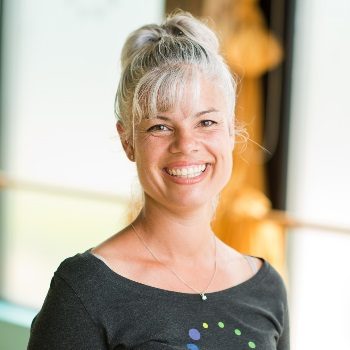
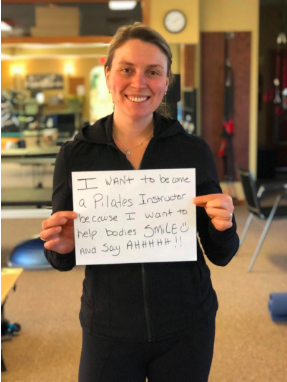
We congratulate MOVE Trainer Angela Sutcliffe on recently becoming a senior trainer! Macarons, music, and movement are some things that come to clients’ minds when they get to know Angela. Meet her below!

  • Angela, it is been awesome seeing your progress in your Pilates/Gyrotonic journey. How did it all start?  I first started doing Pilates in college at Wayne State University. It was required that all dance majors take both Pilates Mat and Reformer because the program believed it was the best way to keep our bodies healthy. I felt changes in my body immediately and knew I needed to do more. I eneded up receiving a scholarship to become an instructor and since then it has spiraled (pun-intended) into what I’m doing today!
  • It is not uncommon for trainers to train on the side, as a weekend gig, and/or teach group classes solely, but you have clearly dedicated yourself to movement as a career, first with Pilates and then with Gyrotonic. What about this profession motivates you to keep consuming more and more? Movement, anything about it (teaching, doing, watching, learning)- it makes me feel whole. I teach Pilates and Gyrotonic but I make it a practice to move every day in any way I can. I want to share the joy I have for movement with others and help them find the freedom of movement that can exist in their body. 
  • When you’re not at the studio, where are you?  I’m never not at the studio! Just kidding, I do go home some nights! I love home because for the first time since high school I have lived in the same place for more than a year. In that time I have been able to make it feel really comfy, calming and charming with my evolving interior decorating skills. I also love trying new recipes. My favorite thing to make these days are macarons! 
  • Where is your favorite place? White Hall, Illinois. Population 2,000. There’s one stop light, an old park with a couple of benches where I spend warm summer days journaling, a little white church that only got indoor plumbing in the last 15 years and a Kroger that is about the size of the group room at MOVE. Most importantly though there’s my Grandpa, the most wholesome, warmest, courageous and kindest heart you will ever meet. He will tell you he loves me more but that is false and he knows it. We have this discussion every time we talk on the phone. 
  • Give us an album recommendation. 

Okay here’s 7 🙂

  • Golden Hour Kacey Musgraves 
  • Off to the Races Jukebox the Ghost 
  • Feels Like Today Rascal Flatts
  • Unapologetically Kelsea Ballerini
  • Dan + Shay Dan + Shay
  • The Blade Ashley Monroe
  • Is Anybody Out There A Great Big World 

What is something that people would be surprised to learn about you? I have 7 nieces and nephews ranging from ages 4-21! I have been Auntie Angela since I was four years old and its my favorite thing to be! They make my life full and entertaining! 

Book a session with Angela and our other lovely trainers here.

Ann Arbor fitness expert Elaine Economou shares her best tips and practices

ANN ARBOR – Elaine Economou shares a glimpse into the movement system she has been teaching for nearly 20 years. The ability to create a fit, vital body for a lifetime, safely and efficiently, is what makes Pilates unique among movement systems.

HOW PILATES TRANSFORMS

A smiling, brunette woman walks into my Ann Arbor studio on a busy Tuesday. This is Susan. I’ve been seeing her twice a week for the last eight years. She’s now in her mid-70s, and when she first came to me, Susan had some functional challenges.

She had scoliosis and a history of surgeries. She no longer had the strength to pull herself out of the pool while playing with her grandchildren and she struggled to walk on the rocky shore of her beloved summer home in Maine.

Now, through safe and effective Pilates exercises, Susan can not only climb out of the pool and walk on the beach, but she can also do planks and squats like a pro.

Moments like these are frequent in Pilates. Moments of healing, fitness, and growth.

WHAT IS PILATES?

Let’s start with what Pilates is not.

It is not a staged Instagram photo of an actress or professional athlete training on some sort of mysterious equipment. Nor is it a painful group fitness class designed to tone your abs, but instead leaving you with neck or low back pain. No, it’s not even “yoga but for core strength.”

It’s a unique, anatomy-based system designed by a forward-thinking visionary, Joseph Pilates. What he knew then, research is just catching up to.

The goal of a Pilates session is to move through the repertoire of exercises at the level and pace that suits you, moving your spine in all planes of motion and challenging your body with different relationships to gravity. Though challenging, the workout and exercises will energize and invigorate.

HISTORY OF PILATES: LET’S MEET JOE

Before creating Pilates — or what he first called “Contrology” — Joseph Pilates was an avid student of movement.

Born in Germany in 1883, Pilates had his own health challenges as a child. Because of this, he was very focused on building his own physical strength. He learned anatomy, wrestling, yoga, martial arts, gymnastics and spent time watching animal movements.

He was traveling as a boxing instructor when the World War I broke out, and he was put in an internment camp in the U.K. It was there that he started consistently working with people doing the exercises that became his repertoire of mat exercises. He also found the basis for his spring-based resistance equipment in working with bedridden injured soldiers by tying sheets onto the bed springs for resistance training.

He was drawn to the Greek ideal of a human – a balance of mind, body, and spirit. This is the heart of Pilates: to let you build the best version of yourself. Pilates believed “we retire too early and we die too young. Our prime of life should be in the 70s and old age should not come until we are almost 100.”

Pilates practiced what he preached. He was just as fit in his 80s as he was in his 40s. This idea – that we can accomplish more than we could ever dream of – shaped the Principles of Pilates: Centering, Concentration, Control, Precision, Breath, and Flow.

PILATES: AHEAD OF ITS TIME?

  • Mindfulness: In Pilates, we start with the breath because “breathing is the first act of life” as Joe said. It is the foundation on which Pilates builds. Today’s research into optimal health points to the very concepts embedded in Joe’s original philosophy.

For instance, evidence supports mindfulness practices — like breathing attentively  — to reduce stress and anxiety. Mindfulness can be a powerful tool for depression as well.

  • Dangers of sitting: 72 years ago when Pilates said “civilization impairs physical fitness,” he was foreshadowing a culture that promotes sitting at a desk for eight hours a day, a culture of automation and transportation that has connected our world beautifully, yet contributed to a dangerous sedentary lifestyle. With this in mind, Pilates designed a system to correct posture, alleviate low back pain, and help with injuries that come from physical inactivity.
  • All the muscles!: In my opinion, Pilates is the optimal post-therapy (and maybe even pre-therapy) fitness. Comprehensive anatomy training is required and we understand muscle balance and human movement. We can tell when your tight glute muscles change the way you walk, or when knee pain may start in your back. If you are a runner, for example, I know that hip and trunk mobility and strength can support optimal running form, so I will include exercises that support these in a session.

There is emerging research demonstrating that practicing Pilates can positively impact depression and anxiety, low back pain, balance and overall physical conditioning.

WHAT PILATES SESSIONS LOOK LIKE

Pilates sessions happen in “private sessions” or “small group trainings.”  A skilled Pilates trainer will create a session using the principles, exercises and equipment tailored to your unique body and goals in private sessions.

For example, you might start with some breathing, spinal movement and then a version of the famous Pilates exercise, the Hundred, on the mat. Then you might move to the reformer and use the spring-based resistance pushing with your feet in a series called “footwork” that helps build strength in the legs.

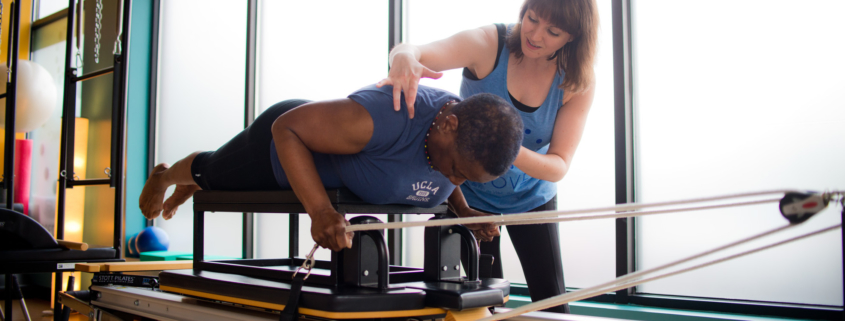
Pilates private session on a reformer.

Read original article here: https://www.clickondetroit.com/all-about-ann-arbor/fit/what-makes-pilates-unique-among-movement-systems

The Gift of Movement

We invite you to share the gift of movement with your family and friends this holiday season. Receive a free Introductory Session with the purchase of a 3-month MOVE Membership customized for that special someone in your life. We’ll wrap it all up in a special MOVE swag bag ready for gifting. 
Be fit. Be well. Be inspired. Be done shopping.

Email us for more information!
We love this time of year because of all of the holiday and wellness inspired food and fitness in the spirit of gratitude. MOVE does its annual gratitude challenge and owner Elaine Economou is hosting a FREE Thanksgiving Gratitude Class on the morning of Thanksgiving. 9 AM at MOVE Westside. Join our Thanksgiving Class. 

Spice up your Thanksgiving table with this delicious cajun cornbread stuffing recipe. Made of andouille sausage, corn bread, red bell pepper, and cayenne pepper, this cornbread recipe will add a colorful kick and excellent side dish. 

Stuffing

Makes 10 servings (about 14 cups)

  • Buttermilk Corn Bread (Recipe below, but it can also be store-bought)
  • 6 tablespoons butter
  • 1 pound andouille or other spicy fully cooked smoked sausage, diced
  • 3 cups chopped red bell pepper
  • 3 cups chopped green onion (about two bunches)
  • 1 cup chopped shallots
  • 1 cup chopped celery
  • 2 tablespoons chopped garlic
  • 2 tablespoons fresh thyme (or 2 teaspoons dried)
  • 2 teaspoons dried sage
  • 1 teaspoon ground allspice
  • ½ teaspoon cayenne pepper
  • ½ teaspoon minced bay leaves
  • 4 large eggs, beaten to blend
  • 2 cups frozen corn kernels
  • 2 cups low-salt chicken broth (can be store bought)
  1. Preheat oven to 350F. Arrange corn bread on large baking sheet. Bake until slightly dry and toasted, about 20 minutes. Transfer to very large bowl; cool.
  2. Melt butter in heavy large Dutch oven over high heat. Add sausage, pepper, green onion, shallot, celery, garlic, thyme, sage, allspice, cayenne, and bay leaves and saute until vegetables are just tender and mixture is very moist, about 15 minutes.
  3. Stir vegetable mixture into corn bread. Season to taste with salt and pepper. Mixture can be prepared one day ahead. Cover and refrigerate. Mix eggs into stuffing.
  4. To bake stuffing in turkey: Add ½ cup chicken broth to stuffing and mix thoroughly. Fill main turkey cavity with stuffing. Mix enough chicken broth into remaining stuffing to moisten. Spoon remaining stuffing into buttered baking dish. Cover tightly with buttered aluminum foil. Bake stuffing in dish alongside turkey until heated through, about 20 minutes. Uncover stuffing and bake until top begins to brown, about 15 minutes.
  5. To bake stuffing in pan: Preheat oven to 350F. Butter 13×9 inch baking dish. Mix 2 cups chicken broth into stuffing. Transfer stuffing to prepared baking dish. Cover tightly with buttered aluminum foil. Bake until stuffing is firm and heated through, about 45 minutes. Uncover stuffing and bake until beginning to brown on top, about 15 minutes.

Buttermilk Corn Bread

You can make this tender corn bread a day ahead.

  • 2 cups yellow cornmeal
  • 1 cup sifted all purpose flour
  • 6 tablespoons sugar
  • 1 tablespoon baking powder
  • ¾ teaspoon salt
  • ½ baking soda
  • ½ cup chilled unsalted butter, diced
  • 1 ½ cups buttermilk
  • 3 large eggs

Preheat oven to 400F. Butter bottom of 9×9 inch baking pan. Mix first six ingredients in food processor. Add butter and cut in, using on/off to pulse, until mixture resembles coarse meal. Beat buttermilk and eggs in large bowl to blend. Add cornmeal mixture to egg mixture and blend. Transfer to prepared pan. Bake until corn bread is light golden brown on top and tester inserted into center comes out clean, about 30 minutes. Cool in pan on rack.

MOVE Wellness owner Elaine Economou shares everyday exercises for a strong core and healthy back.

Originally published on ClickonDetroit.

A while back, I wrote about shifting our perspective of the core beyond the traditional media image of a hard “six-pack.” My hope is that by encouraging people to understand the anatomy of our core, we can build a well-rounded movement routine that supports strength and muscle balance.    

As a mother and CEO of my business and my household, taking care of my own body has not always taken top priority. I witness this attitude among many people I know as well: I’ll exercise once my kids leave for college..I’m not athletic…I’m too busy. Ack!

So let’s shift the way we think of movement. My mantra is “take your vitamins.” Ask your doctor about the ones you swallow but I strongly encourage a movement vitamin in the form of gentle warm ups and simple exercises. I know now – after learning the hard way – that when I don’t do some focused movement every day, it is a slippery slope to back discomfort. Consistently practicing these traditional Pilates exercises below has made a huge difference.

You know how the flight attendants suggest that when you travel with kids that you put your oxygen mask on first? Think of these exercises like that. The benefits will manifest as a slow and steady increase in strength, mobility, stability and yes, energy to do what you love.

The workout should take about twenty minutes, and it includes exercises we use with our clients at MOVE Wellness Studios. In order to get the most out of these exercises, here are some notes for success:

  • Only do as many repetitions that you can manage with good form. Good form for these abdominal exercises means keeping your pelvis stable (not allowing your low back to arch) and your abdominal muscles “hollowed” or pulled tight against your spine.  Once your abs start to fatigue, rest.
  • Good form also includes keeping your chest open and wide.  We often cue the collar bones and your shoulders to stay wide as you move.  
  • Go slow and add repetitions as your endurance increases.  It is absolutely normal to start with toe taps for a week or more before adding the next exercise.  
  • If your back or neck hurts, stop and rest.
  • Get help from a fitness professional or PT if you have had abdominal surgeries, or have been pregnant and you don’t feel your abdominal muscles working. Same if you feel strain in your low back or neck consistently.    
  • Each day you can layer in each exercise and additional repetitions as you get stronger.  

Your Six Safe Core Exercises:

1) Lateral Rocking

Start lying on your back with your knees bent and feet flat on your mat or floor, right next to each other.  Hands are out to the sides of the body in a “T” shape. Start with gentle rocking of the knees to one side and then the other side, not moving too far in either direction. Breathe as you move, and use this at first as a gentle warm up for your back and hips.  Repeat 6-8 sets to warm up. Then, let your knees fall closer to the floor on one side. Using your abdominals, exhale to pull your legs back to upright. Keep switching sides using the breath and your abs to pull your legs upright.

2) Toe Taps

Lying on your back with your knees in tabletop (knees bent and lifted, shins parallel to the floor) with your arms long by your side and gently pressing down into the mat.  Draw your abdominals in and pull your ribs down and toward your hips. Don’t let your pelvis move during the exercise and keep your abdominals and ribs from popping up or out.

Movement: Exhale and start to reach one toe toward the mat.  When you feel that your pelvis might move, lift the leg back up.  Alternate feet for 8 sets or as many as you can do while keeping your pelvis stable.

3) Single Leg Stretch

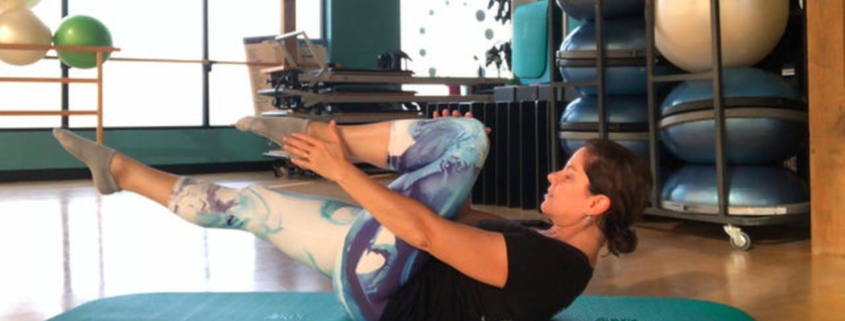
Start in the same position as above and lift your upper body off the mat. Focus on moving into position by drawing the rib cage down with your abdominal muscles and releasing any tension in your neck. Reach your hands toward your knees.  

Movement: Exhale and extend one leg long, keeping the opposite knee pulled in toward the chest. Inhale and move back through the starting position.  Exhale and switch legs. Alternate for 8 sets or as many as you can do while keeping your pelvis stable and abdominals connected.

4) Criss Cross/Obliques

Start in same position as Single Leg Stretch with hands clasped behind head.

Movement: Extend one leg long and keep the opposite knee pulling in toward the chest while crossing the ribs toward the bent leg while exhaling.  Inhale through the center and exhale while switching legs. Keep chest and elbows wide. Alternate for 8 sets or as many as you can do while keeping your pelvis stable and abdominals connected.

5) Scissors

Start in same position as Criss Cross with legs extended above hips and hands reaching toward knees.  

Movement: Exhale and reach one leg toward the floor as the opposite leg reaches toward the ceiling and possibly in toward your chest. Keep feet pointing. Inhale as you switch legs.  Emphasize the length of the leg reaching long. Use the exhale (traditionally there are two pulsating exhales here) to help deepen the contraction of the abs. Alternate for 8 sets or as many as you can do while keeping your pelvis stable and abdominals connected.

To finish:

Hug your knees into your chest and slowly rock side to side.  Then, stretch your arms over your head and your legs long on the floor.  Take a few breaths while actively stretching your body on the inhale and releasing into the floor on the exhale. Take a final breath and allow the weight of your body to rest into the floor. Scan your body from head to toe, and stretch in areas that feel tight. Slowly rise to your feet and take a second to feel long and tall before you go on with your day.  

I hope it is a good one!  

Feel free to email me with questions, elaine@movewellness.com.    

Rectus Abdominis? Transversus? Psoas? If you find yourself wondering what in the world your trainers mean by these muscles, or why anatomy knowledge is even important, then this blog is for you.

Below, Julie Simpson PT, DPT, OCS, talks about the power of anatomy to uncover some amazing things about our bodies. She also talks about how being a Pilates trainer has made her a better Physical Therapist and some fascinating things we can learn about our own bodies. If you’re still on the fence about taking Julie’s Anatomy Course this November 17th, you won’t be after reading this.

How do you think a deeper understanding of anatomy (compared to just knowing superficial knowledge) enhances one’s practice, whether that be as a fitness trainer, PT, or simply someone trying to improve their health?

Pilates is a wonderful system to work the body but by knowing and understanding anatomy, how it is related, what the different muscles do and how they actually have to work systematically opens a beautiful world of knowledge.  It takes a trainer from moving through the paces with a client to actually understanding so much more and then

ultimately helping the client achieve a different level of success.  For example you have a client walk in with their shoulders to their ears (this is really common because so many of us hold our stress in our shoulders and necks.)  As a trainer without the anatomy knowledge you know you need to cue them out of their elevated shoulder posture. You also know a handful of ways to do this but the piece of the puzzle you are missing is that there are specific muscles that downwardly rotate the scapulae, there are muscles that depress the scapulae, and there are muscles that retract the scapulae; by knowing what muscles you are working or need to work the exercises are endless.  It is like fixing a car without actually running a diagnostics test.  When you know your muscles, attachments and actions you can actually solve the problem at hand a whole lot faster.

 What are some things people would be surprised to learn about their own anatomy? (e.g. do we all have a shorter foot? extra bones? etc)

We are all connected!  No really, we are all connected!  I know everyone knows that and says that but I cannot tell you the number of times I see someone with an ankle issue that actually started at their pelvis.  Or that someone with limited shoulder flexion may actually have a rotation at their tailbone.  I am in awe everyday by new connections I see or connections and strategies that bodies use to compensate.  Everyone chases the pain, what I mean by that is you try and stretch the pain, put pressure on the pain, strengthen the area of the pain but the pain is a response to a problem somewhere along the system.  Do not chase the pain, strengthening what is weak, stretch what is tight.

 Often, there’s this idea that our anatomy is mostly genetically-determined. To what extent is this true? What about cultural influences? Besides losing body fat and gaining muscle mass, what else about your body can change? 

So much in our lives can determine our anatomy.   If you sat rotated to the right typing on your computer all day long for 5 days a week you will likely have a mid-back rotation to the right.  When we sit in a posture ALL day long our bodies adapt that posture while we are standing, cooking, walking, etc.  We have the potential to both evoke change for the positive or negative based on our movements and positions.

 As a physical therapist, you are able to bring that deeper perspective to Pilates which I’m sure has been so important to the quality of care your clients receive. If we flip that – has Pilates influenced the way you approach PT at all? Has your experience as a Pilates trainer taught you things about the human body that PT has not? 

ABSOLUTELY!  Pilates is a system that allows me to look at the body as a whole, it allows me to teach clients how to work their entire body and not just one area or zone.  Every one of my PT clients learns many if not all of the Pilates principals.  Pilates trainers have such a gift at doing this naturally.

 Name top 1 or 2 important muscles that people would never think to work out but that play a huge role in our biomechanics. 

Multifidus – Now this is not a muscle I “work-out” per say but it is a muscle that commonly needs to be retrained.  The multifidus will quickly atrophy with back pain, surgery, or a small shift in the spine.

Foot intrinsic muscles with the posterior tibialis – Again there are not little weights for those little muscles. It is about training the brain to understand how the foot needs to work to avoid placing extra stress or strain through the knee, plantar fascia and hip.

Last week, we joined yoga trainer Shannon Walter in a conversation about yoga nidra. This week, we’re diving into how yoga nidra actually feels. What can you can expect from a class? And more!

L: in the video I watched, Dr. Desai says, “yoga nidra gives us the space to choose our reactions to our thoughts.” And I thought that was really beautiful because that concept seems like it’s not only fundamental to yoga– that mindfulness aspect–but yoga nidra seems like a mindfulness on steroi

S: Well it is. There’s this piece about witnessing. You’re not your thoughts. You’re not your ego. You are the witness of those things. You can detach from it. And in yoga in general the philosophy of it is “You’re not your body. Your body is an aspect of your existence.” For most people, they think, this body is me. But yoga nidra is saying, it’s not you. There’s this self that actually we’re all a part. So it’s like how do you get beyond that? It could be that consciousness or that quiet.

L: When I was listening to that I thought about how when I’m driving and someone makes me mad. That would be a great practical moment to have a tool like this  Or when you hear really bad news. You can step back and you’re like, “Okay this how I’m feeling; this is how I’m going to choose to react.”

S: Right! I totally understand that some people may be put off and think oh that’s kooky yoga stuff. But It’s actually a tool that can relax people.

L: Yeah I’ve heard it’s been used for PTSD patients. And I’m sure with mental illness in general it can be beneficial.

S: I would not be surprised.

L: How do you teach yoga nidra and what can we expect from your class?

S: I teach it from my heart! I think it’s a beautiful practice, and hopefully you can expect find a little bit of peace and maybe a little bit more quiet. A little decompression.

L: How long is it?

S: It can be five minutes. In the workshop we’re gonna do stretching because you need your body to be a little bit quiet to take energy inside. The practice itself will be about 40 to 45 minutes. But there’s long pauses. There’s a lot of quiet time.

L: So it can be five minutes?

You’re basically taking components. You can take one component and do that. Focusing on the breathe. Counting from 27 to 1 as you inhale and exhale.

L: With practice, going from that place of big to small, do you get faster the more you do it, or is it always a step-by-step process?

S: It can be anything. Like working out, do you want to have an hour long workout or do you want a 15 minute workout?

L: Ah, I understand. Is there music?
S: Noo. No you don’t want anything. The only sensory input you want is the instructor guiding you. You don’t want candles. You don’t want light. You don’t want music. It’s like single pointed concentration.

L: Do you reach a point where you feel like you’re floating? 

S: There might be a weightlessness. It’s a less of a connection to your body. One thing I love about yoga. Yoga is very systematic practice. And yoga nidra is a very systematic practice for relation and quieting the mind.


Cardio, you say?

Yes! We know that cardio training has a positive impact on health at every age and stage of life and want to support our clients to bring this training into their routines on a regular basis for optimal health.  

Research shows that HIIT (High Intensity Interval Training) is the most effective way to exercise for cardio training:

  • Improves insulin sensitivity
  • Improves post-exercise energy expenditure (E.P.O.C.), in other words, it increases the amount of calories you burn all day
  • Causes a spike in two key hormones: epinephrine and norepinheprine, which play an important role in fat loss. These two hormones (sometimes referred to as adrenaline and noradrenaline: the fight or flight hormones) are responsible for driving lipolysis, which is the breakdown of fat.

What is High Intensity Interval Training (HIIT)?

While there are different types of HIIT training, a great deal of studies characterize HIIT training as bursts of working to your maximum output for 30 seconds to a few minutes and recovery periods. Traditionally people thought that the longer you workout the better. But we know now that’s not the case. With HIIT you can maximize benefits of an hour workout in 20 minutes. 

Cardio Could Save Your Life

Cardio workout significantly improves your VO2 max. This is the max amount of energy consumption your body can use effectively during working out. Why does this matter? VO2 max is a factor in predicting cardiovascular disease and mortality. According to a study in the Journal of Sport Science Blair, et al. report that “risk of low fitness comparable to smoking.” Moderately or highly fit populations can bounce back from illness and disease better than low-fitness individuals. This is irrespective of other factors like obesity, body mass, elPilates-for-Menevated cholesterol, and smoking.

How should I approach my next cardio class?

  • Self-selected pace – work at your body’s pace, not your neighbor’s
  • Listen to your body – do not work through pain
  • Try to have fun – community makes working out easier  
  • Slow and steady wins the race. 

Feeling ‘the burn’ 

In general, when we refer to feeling the burn we’re talking about lactic acid in the muscle groups that we’re working out. But in the cardio world, the burn is a full-body experience. You’re sweating a ton, breathing rapidly and deeply, and your blood is flowing fast.  Some people enjoy this feeling (see runner’s high) and others hate it. Both of those reactions are completely okay. If you’re someone who can’t stand the panting and the exhaustion that comes from a cardio workout,  have hope! Long term, it gets easier and much more manageable. You may even get to that point where you crave a good cardio workout. If you don’t see that happening anytime soon, HIIT in a supportive environment is a great way to knock out your cardio fast.

Articles of interest

Everyone tells us “You need to relax! You need to de-stress.” Okay, well how do I do that?

MOVE member Lorena sat down with yoga nidra practitioner and instructor Shannon Walter for a conversation about yoga nidra benefits and ways in which beginners can get involved. Shannon teaches yoga nidra as a specialty class at MOVE. We’re excited to bring you yoga nidra, because in addition to Pilates and GYROTONIC®, which encourage mindfulness in the physical sense, yoga nidra brings you even deeper emotional and physiological awareness.

 “If you feel stress, join us.” – Elaine Economou, MOVE Wellness Owner 

L: I watched a video from Amrit Yoga in which Dr. Kamini Desai talks about yoga nidra as being “emptying progressively contents of the mind” She says, unlike in meditation where you are aiming for awareness, in yoga nidra, “you are awareness yourself.” Does this resonate with you?

S: So yoga nidra is basically a systematic practice to release tension and stress from the body, the body, and the emotions. Like in layers, it goes from large (physical), then you work on the breathe, which is more subtle, and then you go into visualization. It’s a progression. It’s going from macro to micro.

L: Talk more on “being awareness itself”

S: Way back when yoga nidra was created as a system to explore those levels of consciousness to find self-realization, which is a key aspect of the yoga practice… but it is a great tool just for stress relief. For going to sleep.

L: Well I think that’s really powerful because for beginners…we can be hesitant to try these things. You hear ‘meditation’ and some think ‘okay that’s for yogis or zen people. I can’t do that… I don’t have time do that.” So is yoga nidra something even beginners can jump right into?

S: 100%! You can do it in 5-10 minutes. You can take it as a break at work. It’s just tools.

L: I was reading that yoga nidra is “sleep-based.” Is it similar to sleep?

S: Basically even when you sleep, except for the very deep sleep, your mind is still churning. So with the progression you get to a point where your mind isn’t really churning anymore. You’re quiet.

L: The restorative aspect of yoga nidra – is that the aim to get to this space?

S: I would say, you are systematically quieting your system. Instead of everything going out you’re turning everything in and quieting. And when you’re in that quiet place, if there is something you want to affirm or incorporate in your life, you’re in a prime position to be able to fully receive that thing.

Click here for part 2!

From journey to getting fit post-pregnancy to a becoming a Pilates trainer, meet MOVE Wellness Pilates apprentice Sharon Hillenaar!

Sharon never considered herself particularly athletic. In fact, she says that “hard, core exercise was always a little bit of a struggle.” Given that core exercise is one of the most fundamental components of Pilates, we find Sharon’s story really inspiring for those who are a bit nervous about beginning Pilates.

Staying motivated post-pregnancy

A brand new mom living abroad, Sharon committed herself to post-pregnancy fitness. She started visiting the gym regularly and running, eventually signing herself up for a half-marathon. But the goal to lose weight transformed into a much deeper desire to become fit and live a healthy lifestyle. Sharon started exploring different avenues to becoming fit. She went to the gym, started taking spinning classes, and doing exercise programs like PiYo and Yoga. Her love of spinning became Sharon’s motivation for eventually getting certified as a spinning instructor.

I realized that I really enjoyed being in this type of environment and decided that I would pursue my personal trainers certification, which eventually led to other certifications such as PIYO, Cardio drumming, Schwinn, and a host of other mini classes I took over the years…. As I explored different avenues that would help my career but more importantly my clients, I decided to explore a Pilates Certification. Not knowing ANYTHING about Pilates, I did not realize how intense this form of exercise is for the body, mind, and breath.  I feel like this will be a perfect addition to my experience and training background and will allow me to offer more to my clients not only in a pilates class scenario but also to my overall trainer education.

What was it about Pilates?

One evening during a yoga class I was teaching, one of my clients approached me and mentioned that she had been doing Pilates and how much she enjoyed it. She spoke so enthusiastically about it that I was compelled to go home and read more about it. The more I read, the more I was able to see how beneficial Pilates could be for clients. I was specifically intrigued by the vast repertoire and how effective the movements were to effectuate change within the body especially from a strengthening, mobilization, toning and rehabilitation stand point.

Pilates Benefits for Post-Pregnancy Fitness

For Sharon and many others, Pilates exercises became so beneficial to add to any workout routine. Pilates benefits a wide demographic of people. Pilates can help increase strength, lose inches, heal from injuries, and maintain flexibility and mobility.  Pilates emphasis on deep abdominal connection and pelvic floor health makes it perfect for pregnant and post-natal women.

Finding MOVE’s Instructor Training Program

As I began researching studios that offered the Pilates instructor training program, I stumbled upon the MOVE program. It was perfect for me because the course was offered over the weekends and was in Ann Arbor.  However, that wasn’t the only deciding factor.  After having an extensive conversation with Elaine Economou, who address my lengthy questions and concerns, I truly felt like this program was different. The modulated program, the apprenticeship program and availability to mentors and trainers was exactly what I was looking for.

If you’re a newbie and feeling apprehensive, Sharon offers this advice:

Not having done more than a few Pilates classes myself, I was truly a newbie. Even though I had a background within the fitness industry, there were many occasions when I felt like I was learning things for the first time. At those moments, I reminded myself to breathe and not to be hard on myself. The program is information rich, and at first it will feel like a mumbled heap in your brain. Then all of a sudden, the program comes full circle and it all makes sense.

“This program is not just an instructor training course, it’s an education. Trust the process, believe in yourself and remember, the MOVE program will walk you through, one step at a time.” – Sharon

Start Your Pilates Journey

Sharon is on her way to becoming a Pilates instructor through the MOVE Instructor Training Program and we know she’ll do great! If you have any questions about pilates classes, the MOVE Instructor Training Program or becoming a Pilates instructor, we’d love to chat! Please email us at office@movewellness.com. You can also stop by one of our MOVE Instructor Training Coffee Chats this fall to have your questions answered over a cup of coffee with MOVE Wellness founder and president Elaine Economou.

Meet Sammy Hart, Our Newest Pilates Graduate

  You may recognize Sammy – she’s been teaching yoga at MOVE Wellness for more than three years. She has recently expanded her movement knowledge even further by taking the MOVE Pilates Instructor Training course, and is now a MOVE Pilates Trainer. Find out more about Sammy below!
“I’ve been at MOVE for about 3.5 years and have been teaching yoga for 6. This past year I took a bit of a hiatus to go traveling with my husband which was more amazing than any photo could capture. Returning back to Ann Arbor I find myself once again in the role of student as I finish up my Pilates Reformer course. Pilates has both humbled and inspired me as a movement educator, and I look forward to teaching it. I am curious by nature and find myself in constant studentship whether that’s diving deeper into yoga and pilates, or different modalities of movement. I am fiercely independent, love to travel, eat, and drink good wine… it’s all about balance.”
  CLICK HERE to schedule an appointment with Sammy.